Content based on Brazil's Consolidated Labour Laws (CLT, art. 253) and the official texts of NR 36, NR 29 and NR 9, consulted on 11/11/2026.
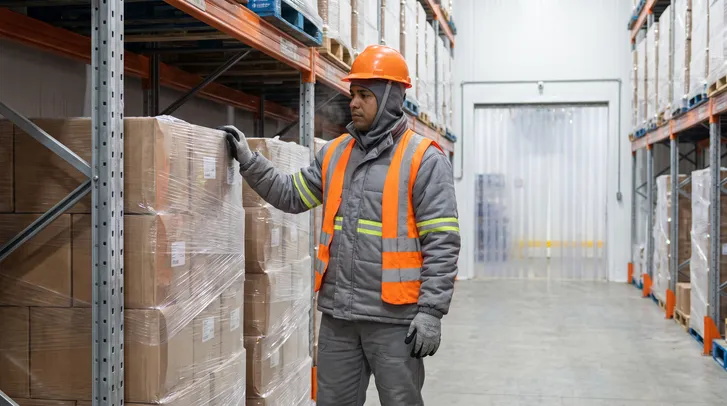
A thermal recovery break (pausa térmica, in Portuguese) is a rest period that lets workers bring their body temperature back to normal after working in cold or heat. For cold, the main rule is in article 253 of the CLT: people who work in cold stores are entitled to 20 minutes of rest for every 1 hour and 40 minutes of continuous work, counted as working time.
Thermal recovery breaks at a glance
| Situation | Source | Rule |
|---|
| Cold stores and moving goods between warm and cold environments | CLT, art. 253 | 20 minutes of rest every 1h40 of continuous work, counted as actual working time |
| What an artificially cold environment is | CLT, art. 253, sole paragraph | Below 15 °C (1st, 2nd and 3rd climate zones), 12 °C (4th zone) and 10 °C (5th, 6th and 7th zones) |
| Meat and poultry processing plants | NR 36, item 36.13.1 | Repeats the rule of 20 minutes after 1h40 in artificially cold environments |
| Refrigerated areas in port work | NR 29, Annex III | Work and thermal recovery regime by temperature range, up to a ban below -73 °C |
| Heat | NR 9, Annex III | Cool water, access to milder places that allow breaks and thermal recovery, and acclimatisation |
What is a thermal recovery break?
It is the time the worker spends outside the cold or hot environment so that their body can return to its normal temperature. It prevents problems such as hypothermia in the cold and heat strain in the heat.
The term is used mostly for cold, because that is where the law sets a fixed break time. For heat, the standards work with prevention measures rather than a fixed interval.
How long is the thermal recovery break in the cold?
Under article 253 of the CLT, it is 20 minutes of rest after 1 hour and 40 minutes of continuous work. The rule applies to those working inside cold stores and to those moving goods from a warm or normal environment into the cold, and vice versa.
This interval counts as actual working time, meaning it is not deducted from the working day.
What is an artificially cold environment?
The sole paragraph of article 253 of the CLT defines it by temperature and by the climate zone of the official map:
- below 15 °C in the first, second and third climate zones;
- below 12 °C in the fourth zone;
- below 10 °C in the fifth, sixth and seventh zones.
NR 36 uses the same limits for meat and poultry processing plants, based on the IBGE (Brazilian Institute of Geography and Statistics) map (item 36.13.1.1).
What does NR 36 say about thermal recovery breaks in meat processing plants?
Item 36.13.1 of NR 36 guarantees, in artificially cold environments, a minimum rest period of 20 minutes after 1 hour and 40 minutes of continuous work, under article 253 of the CLT.
NR 36 also provides for psychophysiological breaks for activities involving muscular overload (item 36.13.2), which are a different kind of break with their own table based on working hours.
What about port work in refrigerated areas?
NR 29 requires the regime in its Annex III to be followed in refrigerated areas (item 29.24.2). The table varies with the dry-bulb temperature:
| Temperature | Regime in the cold environment |
|---|
| From +15.0 °C (or +12.0 / +10.0 °C, depending on the climate zone) to -17.9 °C | 6h40 in total, in four periods of 1h40 alternating with 20 minutes of rest and thermal recovery |
| From -18.0 °C to -33.9 °C | 4 hours in total, alternating 1 hour of work with 1 hour of thermal recovery |
| From -34.0 °C to -56.9 °C | 1 hour in total, in two 30-minute periods, with at least 4 hours of recovery between them |
| From -57.0 °C to -73.0 °C | 5 minutes in total; the rest of the working day outside the cold environment |
| Below -73.0 °C | Exposure prohibited, whatever the clothing |
Learn more about NR 29 and port work.
Is there a thermal recovery break for heat?
There is no fixed interval as there is for cold. Annex III (Heat) of NR 9 sets out prevention measures, including:
- providing cool drinking water and encouraging workers to drink it (item 4.1.1, a);
- providing access to places, including natural ones, that are thermally milder, allowing breaks and thermal recovery (item 4.2.2, c, amended by MTE Ordinance No. 105/2026);
- taking workers' acclimatisation into account, as described in the PCMSO (Occupational Health Medical Control Programme) (item 5.1);
- providing clothing suited to the type of exposure (item 4.1.2).
Heat is assessed using the WBGT index (IBUTG in Portuguese). For the unhealthy work allowance, the reference is Annex 3 of NR 15, which also uses the WBGT. See what NR 15 is and NR 21, on outdoor work.
How to apply thermal recovery breaks in practice
- Map the environments. Measure the temperature of cold stores and hot areas and record it in the PGR (Risk Management Programme) risk inventory.
- Identify who is exposed. Include those who go in and out of the cold to move goods.
- Draw up the break schedule. Spread the 20 minutes every 1h40 without stopping the operation, using rotation.
- Provide a place to recover. The break must take place outside the cold or hot environment.
- Provide suitable clothing and PPE. Thermal clothing for cold and clothing suited to heat.
- Record and monitor. Keep the schedule and records to prove compliance.
How GAP helps
GAP's PGR and Service Order service takes an inventory of the operation's physical risks, such as heat and cold, with qualitative and quantitative analysis and an action plan. The service orders for each role inform every worker of the thermal risks and prevention measures, such as breaks.
Does your operation have cold stores or hot areas? Request a proposal for PGR and Service Order.
Frequently asked questions about thermal recovery breaks
How long is a thermal recovery break?
In the cold, it is 20 minutes of rest for every 1 hour and 40 minutes of continuous work, under article 253 of the CLT. This interval counts as actual working time.
Does the thermal recovery break count as working time?
Yes. Article 253 of the CLT states that the 20-minute interval counts as actual working time, meaning it is not deducted from the worker's working day.
Who is entitled to a thermal recovery break?
Those who work inside cold stores and those who move goods from a warm or normal environment into the cold, and vice versa (CLT, art. 253). NR 36 applies the same rule to artificially cold environments in meat and poultry processing plants.
At what temperature is an environment considered cold?
It depends on the climate zone. An environment is artificially cold below 15 °C in the 1st, 2nd and 3rd zones, below 12 °C in the 4th zone and below 10 °C in the 5th, 6th and 7th zones (CLT, art. 253, sole paragraph).
Is there a mandatory thermal recovery break for heat?
There is no fixed interval in law. Annex III of NR 9 requires measures such as cool water, acclimatisation and access to milder places that allow breaks and thermal recovery, defined based on the heat assessment.
Official sources
Read also