Content based on the official texts of NR 13, NR 33, NR 35 and Law No. 6,019/1974, consulted on 06/11/2026.
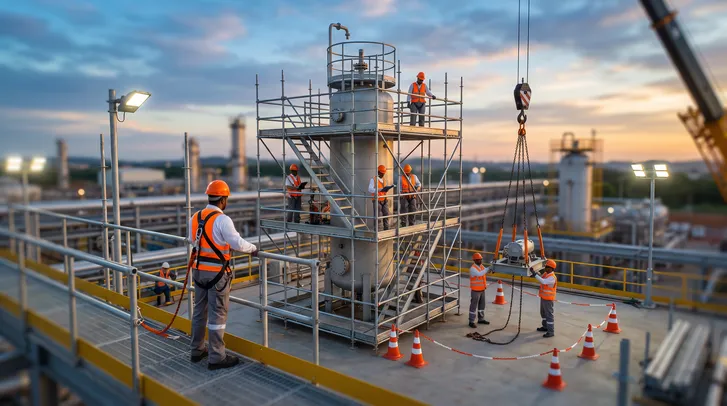
A plant shutdown (parada geral de fábrica, in Portuguese) is the planned stoppage of a plant to carry out maintenance, mandatory inspections and improvements that cannot be done while the operation is running. In just a few days, the company receives many contractors and concentrates high-risk activities, such as work at height and in confined spaces, that require work permits and up-to-date training.
Plant shutdown at a glance
| What happens during the shutdown | Standard and item | What it requires |
|---|
| Contractors working at the plant | Law 6,019, art. 5-A, § 3 | The contracting company ensures safety conditions for contractors on its premises |
| Non-routine work at height | NR 35, 35.5.7 and 35.5.8.2 | Prior Permit to Work (PT), valid only for the activity and restricted to the shift or working day |
| Training for work at height | NR 35, 35.4.2.1 and 35.4.2.2 | 8 hours initially and 8 hours every two years |
| Confined spaces | NR 33, 33.5.5, 33.5.12 and 33.5.9 | Entry and Work Permit (PET) before every entry, valid for one working day and kept for 5 years |
| Training for confined spaces | NR 33, Annex III | 40 hours for entry supervisors and 16 hours for attendants and authorised entrants, with an annual 8-hour refresher |
| Boilers and pressure vessels | NR 13, 13.4.4.4 and 13.5.4.5 | Periodic safety inspection within maximum intervals, such as 12 months for category A and B boilers |
| NR 13 inspection report | NR 13, 13.3.8 | In the case of a general maintenance shutdown, up to 90 days for the report |
What is a plant shutdown?
It is the period in which the plant, or one of its units, stops producing in a planned way. It is also called a planned shutdown, maintenance shutdown or turnaround.
The shutdown is used for work that requires equipment to be stopped: major maintenance, parts replacement, internal cleaning, mandatory inspections of boilers and pressure vessels, and improvement projects. It is different from an emergency shutdown, which happens without planning because of a failure.
Why is a plant shutdown a critical moment for safety?
Because several risk factors add up at the same time:
- many contractors, from several companies, who are not familiar with the plant day to day;
- non-routine activities, such as work at height, confined spaces, welding and electrical work;
- simultaneous work fronts in the same area, with the risk of one activity interfering with another;
- a tight schedule, because every day of downtime is a day without production.
And responsibility remains with the company: under Law No. 6,019/1974, art. 5-A, § 3, the contracting company must ensure safety conditions for contractors working on its premises.
What do the standards require during a shutdown?
Work at height (NR 35). Every non-routine activity at height must be authorised in advance by a PT (Permissão de Trabalho, Permit to Work) (35.5.7). The PT must include the minimum requirements, the measures from the risk analysis and a list of everyone involved (35.5.8.1). It is valid only for that activity, restricted to the shift or working day, and must be closed and filed at the end (35.5.8 and 35.5.8.2).
Confined spaces (NR 33). Every entry requires a PET (Permissão de Entrada e Trabalho, Entry and Work Permit) issued in advance (33.5.5), signed by the entry supervisors and attendants (33.5.6). The PET is valid for one working day (33.5.12) and must be kept for 5 years (33.5.9).
Boilers and pressure vessels (NR 13). The shutdown is usually when periodic inspections take place, which have maximum intervals by category (13.4.4.4 for boilers and Table 2 of item 13.5.4.5 for vessels). In the case of a general maintenance shutdown, the standard allows up to 90 days for the inspection report (13.3.8).
Training. Each contractor should only start the activity with valid required training, such as the 8-hour NR 35 courses and the 16- or 40-hour NR 33 courses.
How to plan a plant shutdown in practice
- Define the scope and schedule. List all the services, areas and companies involved.
- Contract and mobilise early. Request contractors' documents weeks in advance, not on the day they arrive.
- Build the training matrix. Link each activity to the required training and check validity for the entire duration of the shutdown.
- Carry out the risk analyses. Prepare the PHAs (APR, Análise Preliminar de Risco) and the PT and PET templates before starting.
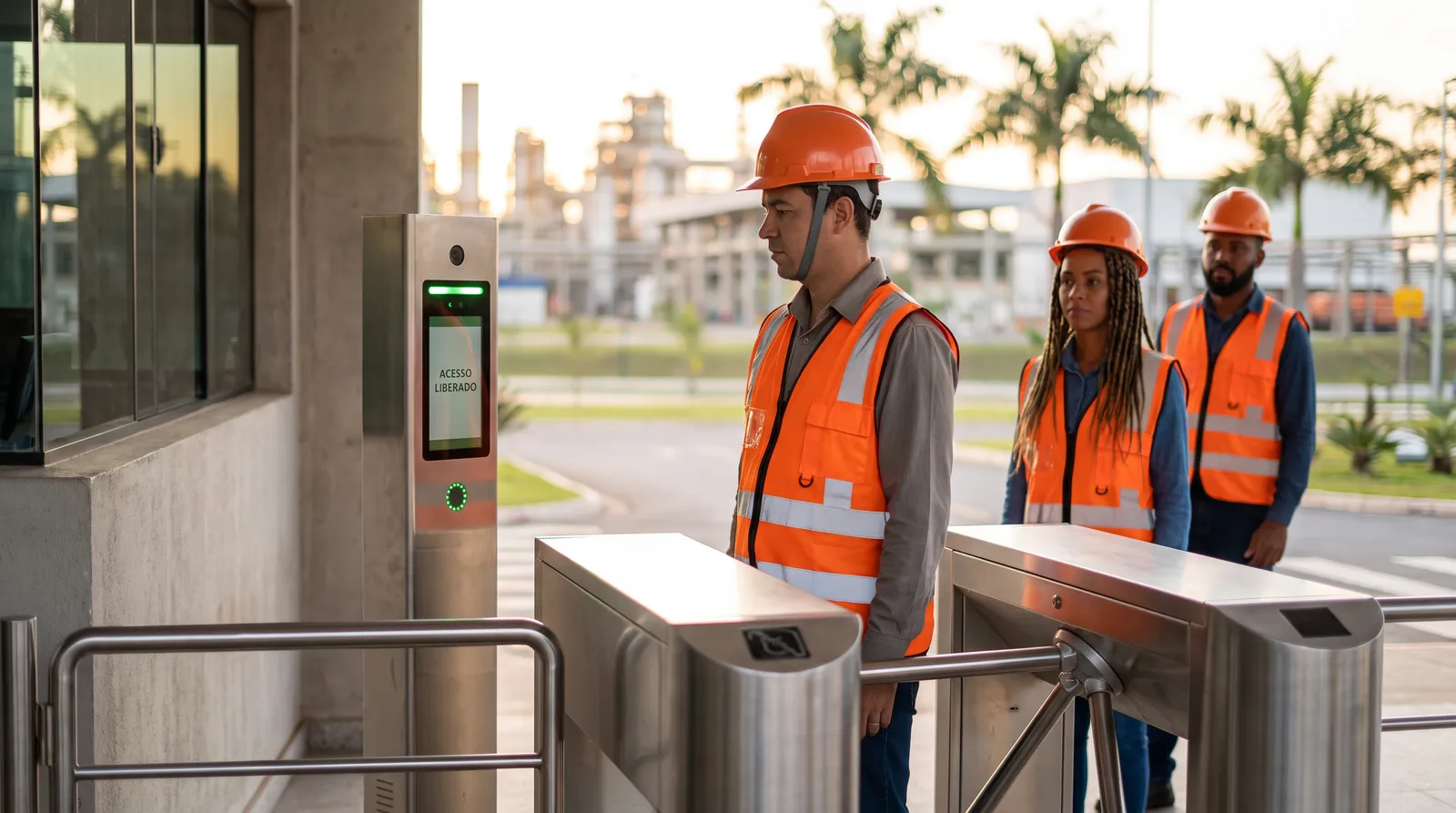
- Control access. Only let in at the gate those whose documentation has been approved.
- Track work fronts in real time. Know which PTs are open and where, to avoid conflicting activities.
- Close out and record. Close the PTs and PETs, file the records and gather lessons learned for the next shutdown.
Points to watch: leaving document review until the week of the shutdown creates queues at the gate and pressure to let contractors in without checks.
How GAP helps with a plant shutdown
GAP's Third-Party Management helps mobilise contractors in advance:
- documentation criteria by role and activity, plus AI pre-analysis to speed up validation;
- real-time status for each professional, with access granted or blocked and expiry alerts;
- integration with turnstiles and facial recognition, and QR Code badges.
Digital Work Permit, integrated with Third-Party Management, organises the work fronts:
- automatically validates training and blocks anyone who is not qualified;
- links the PHA to the PT, with an approval workflow and digital signature;
- shows all active PTs at the plant on a map;
- works offline in the app, right in the field.
Got a plant shutdown coming up? Schedule a demo and see how to mobilise contractors and issue PTs without paper.
Frequently asked questions about plant shutdowns
What is a plant shutdown?
It is the planned interruption of production at a plant or unit to carry out maintenance, mandatory inspections and improvements that require the equipment to be stopped. It is also called a planned shutdown, maintenance shutdown or turnaround.
What is the difference between a planned shutdown and an emergency shutdown?
A planned shutdown is planned in advance, with a defined scope, schedule and contracts. An emergency shutdown happens without planning, because of a failure or accident, and therefore tends to involve more risk and cost.
How long is a permit for work at height valid?
Under item 35.5.8.2 of NR 35, the PT is valid only for as long as the activity lasts and is restricted to the shift or working day. It can be revalidated by the person responsible for approval, provided the conditions and the team have not changed.
How long must a confined space PET be kept?
For 5 years. Item 33.5.9 of NR 33 requires this retention period, and 33.5.9.1 states that PETs must be available to workers on request.
What is the deadline for the NR 13 inspection report after a plant shutdown?
Item 13.3.8 of NR 13 allows up to 90 days for the inspection report in the case of a general maintenance shutdown.
Official sources
Read also