Content based on Law No. 6,019/1974 and Brazil's General Data Protection Law (LGPD, Law No. 13,709/2018), consulted on 06/11/2026.
Contractor access control is the process that defines which professionals from contracted companies can enter the company, which areas they can access and for how long. Entry is only granted to those whose documents and training are up to date. Under Brazil's Law No. 6,019/1974, the contracting company is responsible for the safety conditions of contractors working on its premises.
Contractor access control at a glance
| Topic | What the law says |
|---|
| Contractor safety | The contracting company must ensure safety, hygiene and health conditions when the work is carried out on its premises (Law 6,019, art. 5-A, § 3) |
| Labour obligations | The contracting company is secondarily liable for the period in which the service is provided (art. 5-A, § 5) |
| Contractor's activity | Using contractors for activities other than those set out in the contract is prohibited (art. 5-A, § 1) |
| Biometrics | Biometric data is sensitive personal data (LGPD, art. 5, II) |
| Using biometrics without consent | Allowed when essential to comply with a legal obligation or for fraud prevention and the data subject's security in identification and authentication (LGPD, art. 11, II, a and g) |
What is contractor access control?
It is the set of rules and tools that decides, at the gate, whether a service provider can enter or not. Good control answers three questions: who the person is, whether they are qualified to do that job, and which areas and times they are allowed to be on site.
This applies to any contractor: maintenance, cleaning, construction, industrial assembly or teams hired for a plant shutdown.
Why does the contracting company need to control contractor access?
Because the law places part of the responsibility on it. Article 5-A of Law No. 6,019/1974, added by Law No. 13,429/2017, states that:
- the contracting company must ensure safety, hygiene and health conditions for workers when the work is carried out on its premises (§ 3);
- the contracting company is secondarily liable for labour obligations for the period in which the services are provided (§ 5);
- contractors may not be used for activities other than those contracted (§ 1).
In practice, letting someone in without training or with an expired document means taking on a risk the company could have avoided at the gate. See also how Brazil's Outsourcing Law handles secondary liability.
What should be checked before letting a contractor in?
The exact list depends on the activity and the standards that apply to it. In general, the company checks:
- from the contracted company: the contract or work order, with the scope of the work;
- from the worker: identification, employment link with the contractor and occupational health certificate (ASO, Atestado de Saúde Ocupacional);
- training: whatever the activity requires, such as NR 10 for electricity, NR 33 for confined spaces and NR 35 for work at height;
- PPE: the record of personal protective equipment issued;
- induction: the company's own safety induction;
- validity: whether all these items remain valid throughout the service period.
For the full list, see which documents to require in third-party management.
| Method | How it works | Limitation |
|---|
| Gate with a list or spreadsheet | The gatekeeper checks the name against a list sent by the department | Does not show whether a document expired yesterday |
| QR Code badge | The badge is scanned in the field and shows the professional's status | Depends on someone scanning the code |
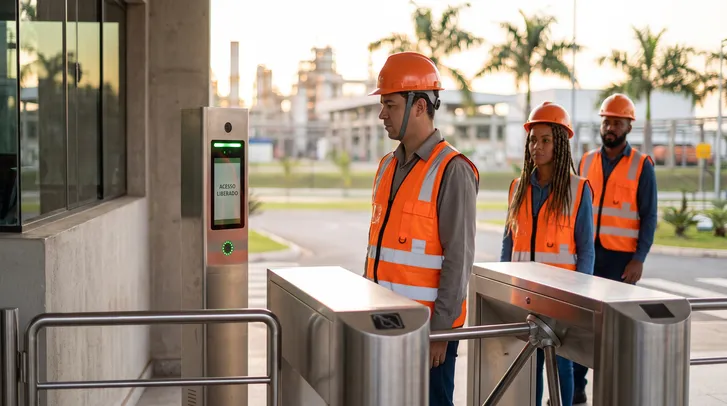
| Turnstile with facial recognition | The turnstile only lets in those cleared in the system | Involves biometric data and requires care with the LGPD |
The safest methods have one thing in common: entry depends on the real-time status of the documentation, not on a list made days earlier.
Biometric access control and the LGPD
The LGPD classifies biometric data as sensitive personal data (art. 5, II). This type of data may only be processed in the cases set out in art. 11.
Without the data subject's consent, its use is allowed when essential, among other cases, to comply with a legal or regulatory obligation (art. 11, II, a) or for fraud prevention and the data subject's security in identification and authentication processes (art. 11, II, g). The company must define the legal basis, limit who can see this data and record who accesses it.
How to implement contractor access control in practice
- Build the document matrix. Define which documents and training each role or activity requires.
- Centralise submissions. Ask contractors to send everything through a single channel before the service begins.
- Validate with defined owners. Establish who approves each type of document.
- Link validation to the gate. The cleared or blocked status should reach the gate or turnstile automatically.
- Track expiry dates. A document that expires mid-service should block access until it is renewed.
- Review regularly. Adjust the matrix when new activities or standards come up.
How GAP helps with contractor access control
GAP's Third-Party Management links document review to entry at the gate:
- documentation criteria customised by role, activity and industry;
- validation workflows with stages and owners, plus AI pre-analysis to find inconsistencies in documents;
- real-time status for each contractor, with access granted or blocked and expiry alerts;
- QR Code badges to check status in the field;
- integration with turnstiles and facial recognition, so that only 100% compliant professionals get in.
Want your gate to let in only contractors with up-to-date documentation? Schedule a demo of GAP's Third-Party Management.
Frequently asked questions about contractor access control
Is the contracting company responsible for contractors' safety?
Yes, when the work is carried out on its premises or at a location agreed in the contract. Article 5-A, § 3 of Law No. 6,019/1974 states that the contracting company is responsible for ensuring safety, hygiene and health conditions for these workers.
Can a contractor carry out an activity other than the one contracted?
No. Paragraph 1 of art. 5-A of Law No. 6,019/1974 prohibits the contracting company from using workers for activities other than those set out in the contract. That is why access control should also take into account the activity and area cleared for each person.
Can I use facial recognition to control contractor access?
Yes, as long as the company complies with the LGPD. Biometric data is sensitive (art. 5, II) and may only be processed in the cases set out in art. 11, such as compliance with a legal obligation or fraud prevention and the data subject's security in identification processes.
What is the difference between access control and third-party management?
Third-party management covers the whole relationship with contracted companies: documents, training, evaluation and compliance. Access control is the part that turns that analysis into a decision at the gate: in or out.
What should be done when a document expires during the service?
Ideally, access should be blocked automatically until the contractor sends the renewed document. With spreadsheet-based control, this expiry often goes unnoticed; with real-time status, the gate itself is informed.
Official sources
Read also