Standards
NR-10: Authorization and Work Permit for Electricity
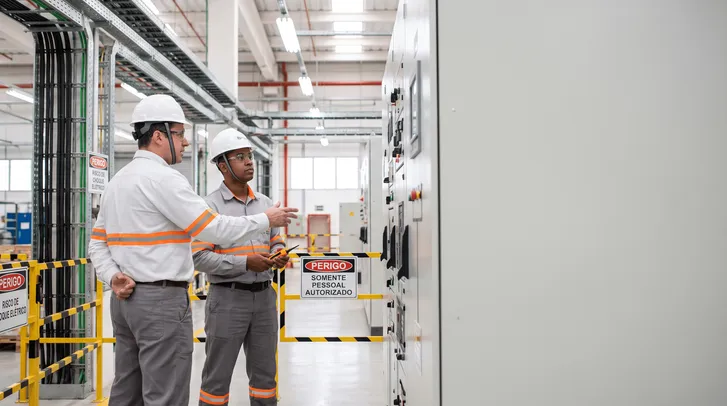
Understand the NR10 electrical safety rules, who is authorized to work, the issuance of the PT (Work Permit), and what changes with the new 2026 revision.
By: Vitória Willemann
Understand the NR10 electrical safety rules, who is authorized to work, the issuance of the PT (Work Permit), and what changes with the new 2026 revision.
By: Vitória Willemann
Electric energy is an invisible and fatal hazard. Unlike a moving machine or working at height, electricity emits no sound and cannot be seen before contact. Due to this unpredictability, any intervention in electrical installations requires an extreme level of control and planning.
The basis of this control lies in the NR10 electrical safety standard, which requires documentation, rigorous planning, and a formal release for workers to perform tasks on the electrical grid.
In this article, we will detail how the authorization for electrical work works, when a Work Permit (PT) is indispensable, how NR-10 guidelines connect with the rest of your company's safety ecosystem, and what changes with the new revision of the standard.
Regulatory Standard 10 (NR-10) establishes the minimum requirements and conditions to guarantee the health and safety of workers who interact directly or indirectly with electrical installations and services involving electricity.
Its basic premise is de-energization. The general rule of the standard is that electrical interventions can only occur with the system completely de-energized (and locked out). Working on energized circuits is the exception and requires technical justifications, special protocols, and double protection barriers.
In the industrial environment, simply having training in the electrical field is not enough to perform interventions. NR-10 establishes that technical knowledge is only the first step, not the guarantee of authorization to work.
To work on the grid, professionals must have the nr10 work authorization, which is a formal document granted by the company. See the classification of profiles required by the standard:
| Profile | Definition according to NR-10 |
|---|---|
| Qualified | A professional who has completed a specific course in the electrical field recognized by the Official Education System. |
| Certified / Registered | A qualified professional registered with the competent class council (CREA, CFT, etc.). |
| Trained | A worker who has received training under the guidance of a registered professional and works under their responsibility. |
| Authorized | A qualified or trained worker who, in addition to having up-to-date NR-10 training and medical exams (ASO), has received formal consent from the company to intervene in the installations. |
Only authorized workers can perform electrical interventions, and the authorization status must always be explicitly displayed on the employee's badge.
Even if a worker is qualified, registered, and authorized by the company, they cannot simply open a panel and start maintenance. This is where operational lockout comes in: the Work Permit.
The issuance of the PT is mandatory, according to NR-10, for services performed in High Voltage (HV) or on energized electrical installations. The document acts as an immediate checklist at the job site, certifying that the appropriate personal protective equipment (PPE) is being used and that the area has been properly signed and isolated.
If your operation needs to structure this flow, understanding in detail what a Work Permit is will help define the responsibilities of whoever issues, verifies, and executes the task.
Before the Work Permit is signed on the factory floor, the task had to be planned. No complex electrical activity proceeds without a Preliminary Hazard Analysis (PHA).
The PHA is the technical study where the safety engineer or technician details the steps of the maintenance, predicts failures (such as electric arc, shock, or short circuit), and defines the necessary barriers (flame-resistant clothing, insulating gloves, and appropriate tools). Since it is the foundation of all safe planning, knowing exactly what a preliminary hazard analysis (PHA) is and how to structure this document prevents unwanted surprises and accidents at the time of execution.
To reinforce accident prevention and demand even more rigorous planning from companies, the Ministry of Labor and Employment published the fifth revision of NR-10 (MTE Ordinance No. 737, of May 29, 2026).
The new wording focuses on modernizing requirements and harmonizing with the current Occupational Health and Safety regulatory structure (such as the PGR), improving the way electrical risks are managed.
Important deadlines and adjustments:
In industries, risks rarely exist in isolation. It is common for the authorization for electrical work to need to be combined with other high-risk work permits.
If your electrical team needs to intervene in complex environments, the documentation and precautions multiply. See the main intersections of NR-10 with other standards:
Ensuring full compliance with NR-10 is not just a matter of avoiding fines, but of saving lives. Structure clear processes, ensure that only authorized personnel touch installations, prepare for the new updates to the standard, and never skip documentation rigor when issuing PHAs and Work Permits.
Find out what NR 13 establishes, why safety inspections of boilers and pressure vessels matter, and the role of the Qualified Professional (PH).
Understand the NR 11 rules for safe transport, handling, storage and manipulation of materials with forklifts, overhead cranes and cranes.
Understand what the updated NR 9 is, how it governs the assessment of physical, chemical and biological agents, and its direct link with the PGR (NR 1).
Get to know NR 8 and understand the technical requirements for ensuring the safety, thermal comfort and structural stability of buildings used as workplaces.
Understand what NR 6 is, the employer's responsibilities when issuing PPE, the worker's duties and how to streamline PPE control in your company.
Understand what NR 5 is, its sizing rules, the election process deadlines and the standard's new requirements on combating harassment in companies.
Simplify your Risk Management, reducing liabilities and ensuring safe, standardized, and auditable operations with fast implementation and advisory support.