Standards
Work Permit for Load Lifting: Risks and How to Draw One Up
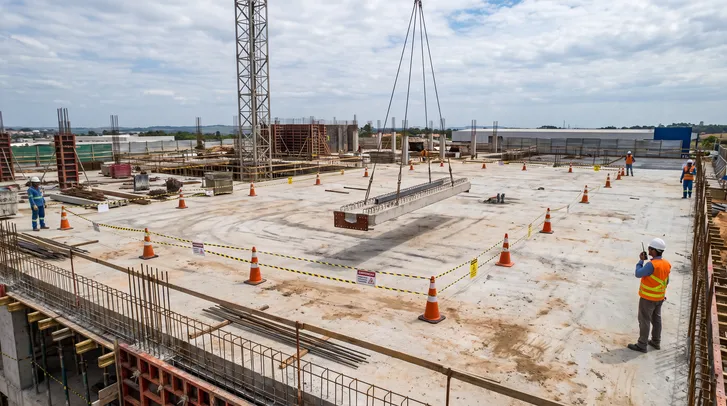
Understand the risks involved in load lifting, what must be checked in the operation, and how to structure the Work Permit (PT) for lifting.
By: Vitória Willemann
Understand the risks involved in load lifting, what must be checked in the operation, and how to structure the Work Permit (PT) for lifting.
By: Vitória Willemann
Moving heavy materials in industry and on construction sites demands technical rigour and advance planning. Operational failures — excess weight on the equipment or incorrect rigging, for instance — can result in serious accidents and significant material losses.
To guarantee the safety of the operation, engineering uses a Rigging Plan (the technical lifting study). Releasing the team to carry out the planned movement, however, requires documentary validation at the work front. That is what the work permit for load lifting is for.
In this article we detail the risks involved in load lifting, the mandatory inspection points before the operation, and how to structure this formal release.
Load lifting is the operation of raising and moving heavy or bulky materials using specific equipment such as mobile cranes, overhead travelling cranes, tower cranes, gantries and hoists.
Despite the technology built into this equipment, the human variable (the operator and the signaller/rigger) and the environmental conditions are decisive for safety. The most critical risks in this operation include:
The work permit for lifting is the formal document authorising the movement to begin. It works as a final verification checklist, validating whether every preventive measure planned in the Preliminary Risk Analysis (APR) and the Rigging Plan has actually been implemented on site.
The absence of a work permit for load lifting removes the double-check of safety conditions, leaving the operation without documentary backing and out of step with Environment, Health and Safety (EHS) guidelines.
Issuing this release attests that the area has been isolated and that the workers involved are aware of the machine's radius of action while the load is suspended.
The lifting permit must be issued at the operation site, immediately before the movement begins. The verification items are based on regulatory requirements, in particular NR-11 (Transport, Movement, Storage and Handling of Materials).
The safety team and those responsible for the task must inspect and validate points such as:
| Item inspected | Technical point of attention |
|---|---|
| Rigging accessories | Visual inspection of steel cables, textile slings, chains and shackles. Accessories must show no wear, cuts or deformation that reduces their capacity. |
| Isolation and signage | The entire radius of action (crane slew and load path) must be physically isolated with hazard tape, barriers or cones. |
| Weather conditions | Check wind speed. The operation must stop in case of winds beyond the equipment's limit, heavy rain or lightning. |
| Communication | Validate that two-way radios work and that hand-signal standards between the signaller and the machine operator are agreed. |
| Ground stability | Confirm that the crane's mats and outriggers are properly supported on firm, level ground. |
One particularity of load lifting is how often it overlaps with fall risk exposure. In many industrial and construction operations, the load is lifted from the ground but must be received and positioned by workers on elevated platforms, silo tops, slabs or steel structures.
In those scenarios, the documentation requires simultaneous care. The worker receiving, guiding and unhooking the suspended load must be properly anchored. To make sure the plan covers all these stages, it is worth also applying the rules covered in our article on steps to bring the company into line with work at height (NR-35).
Rigour in issuing and checking safety items daily is what guarantees a load movement free of failures. How has your team been completing and storing these releases before starting operations with heavy machinery?
Understand what NR 14 is, the mandatory requirements for installing, lining and safely operating industrial furnaces, and how to avoid explosion risks.
Find out what NR 13 establishes, why safety inspections of boilers and pressure vessels matter, and the role of the Qualified Professional (PH).
Understand the NR 11 rules for safe transport, handling, storage and manipulation of materials with forklifts, overhead cranes and cranes.
Understand what the updated NR 9 is, how it governs the assessment of physical, chemical and biological agents, and its direct link with the PGR (NR 1).
Get to know NR 8 and understand the technical requirements for ensuring the safety, thermal comfort and structural stability of buildings used as workplaces.
Understand what NR 6 is, the employer's responsibilities when issuing PPE, the worker's duties and how to streamline PPE control in your company.
Simplify your Risk Management, reducing liabilities and ensuring safe, standardized, and auditable operations with fast implementation and advisory support.