Standards
What Is NR 23? Fire Protection Rules for Businesses
Understand what NR 23 is, the fire protection standard, its requirements for escape routes and its relationship with the state AVCB in occupational safety.
By: Vitória Willemann
Understand what NR 23 is, the fire protection standard, its requirements for escape routes and its relationship with the state AVCB in occupational safety.
By: Vitória Willemann
Fire risk has nothing to do with a company's line of business. From construction sites to industrial parks, fire is a critical threat to workers' lives and to the operation itself. To standardise prevention and emergency response, Brazilian labour legislation has a specific standard for this. In this article, we explain what NR 23 is, its operational requirements and how it fits together with Fire Department rules in the day-to-day of EHS.
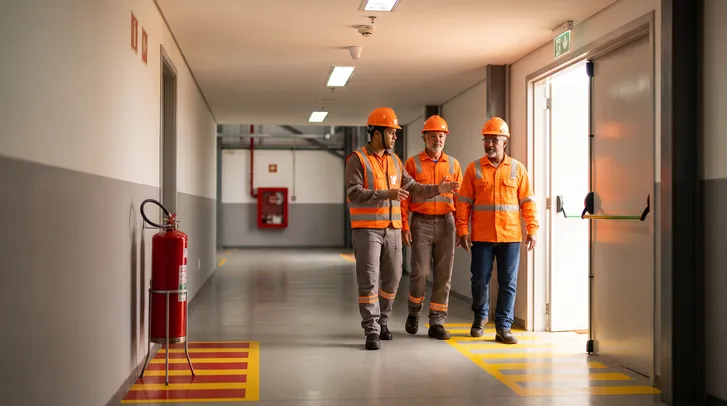
Regulatory Standard 23 (NR-23) sets out fire protection measures for businesses and workplaces. Its purpose is to make sure every organisation has the conditions for a fast, safe evacuation, and to instruct workers on how to act when an emergency starts.
In its current, updated form, NR-23 is a lean standard, classified as a Special Standard. It does not spell out the technical specifications for extinguishers or fire-load calculations. Instead, in item 23.3.1, the standard requires the company to adopt prevention measures in line with state legislation and, in addition, with official technical standards (such as those from ABNT, the Brazilian standards body).
That means that, from the Ministry of Labour's point of view, failing to comply with your state Fire Department's rules is also a breach of NR-23.
Even though it delegates most of the technical parameters to the states, NR-23 places direct administrative and structural obligations on the employer. The EHS department must ensure compliance with the following points:
Since NR-23 requires compliance with state legislation, the company's legal and operational security depends on obtaining and maintaining the Fire Department Inspection Certificate (AVCB) or an equivalent document.
The AVCB certifies that the building has the required protection systems (such as hydrants, extinguishers, sprinklers and emergency lighting). Operating without a valid AVCB, or with firefighting systems out of service, not only breaches state legislation but also exposes the company to shutdown orders from labour inspectors, based on NR-23 and NR-3 (Embargo and Shutdown).
Guaranteeing fire protection takes continuous monitoring. Extinguishers expire, escape routes get blocked inadvertently by the day-to-day flow of the operation, and the team needs periodic refresher training on evacuating the area. The SESMT's big challenge is to orchestrate all these variables without missing critical deadlines.
Keeping control of equipment inspections, AVCB expiry dates and fire brigade members' documentation calls for well-aligned processes. To make that management effective, it is essential to adopt rigorous field-verification routines, linking structural monitoring to proper document control for employees and contractors. That way, the company makes sure both its infrastructure and its people's preparedness are perfectly aligned to respond to any emergency.
Find out what NR 13 establishes, why safety inspections of boilers and pressure vessels matter, and the role of the Qualified Professional (PH).
Understand the NR 11 rules for safe transport, handling, storage and manipulation of materials with forklifts, overhead cranes and cranes.
Understand what the updated NR 9 is, how it governs the assessment of physical, chemical and biological agents, and its direct link with the PGR (NR 1).
Get to know NR 8 and understand the technical requirements for ensuring the safety, thermal comfort and structural stability of buildings used as workplaces.
Understand what NR 6 is, the employer's responsibilities when issuing PPE, the worker's duties and how to streamline PPE control in your company.
Understand what NR 5 is, its sizing rules, the election process deadlines and the standard's new requirements on combating harassment in companies.
Simplify your Risk Management, reducing liabilities and ensuring safe, standardized, and auditable operations with fast implementation and advisory support.