Content based on the official text of NR 36 and Brazil's Consolidated Labour Laws (CLT, art. 253), consulted on 12/11/2026.
NR 36 is the Brazilian Regulatory Standard that sets the minimum requirements for assessing, controlling and monitoring risks in the slaughter and processing of meat and meat products for human consumption. Among other rules, it sets psychophysiological breaks according to working hours and 20 minutes of rest every 1h40 in artificially cold environments. It was approved by MTE Ordinance No. 555/2013.
NR 36 at a glance
| Topic | What NR 36 says |
|---|
| Scope | Slaughter and processing of meat and meat products for human consumption (item 36.1.1) |
| Psychophysiological breaks | 20, 45 or 60 minutes, depending on working hours (36.13.2, Table 1) |
| Artificially cold environment | 20 minutes of rest after 1h40 of continuous work, under article 253 of the CLT (36.13.1) |
| Cold rooms at -18 °C or below | Must display the maximum time workers may stay inside (36.2.10.1.1) |
| Workstations | Alternation between standing and sitting (36.2.1) and at least one seat for every three workers at stationary workstations (36.2.2) |
| Knives | A system to control knife sharpening (36.8.10, b) |
| Legal basis | MTE Ordinance No. 555/2013, as amended up to MTE Ordinance No. 1,065/2024 |
What is NR 36 and who does it apply to?
NR 36 is the Ministry of Labour and Employment's standard for meat processing plants. Under item 36.1.1, it applies to companies that slaughter and process meat and meat products for human consumption, such as poultry, pork and beef.
The standard focuses on risks typical of the sector: repetitive movements, cold, knife use and lifting loads.
How do NR 36 psychophysiological breaks work?
Item 36.13.2 sets breaks according to the length of the working day:
| Working hours | Tolerance for applying the break | Break time |
|---|
| Up to 6h | Up to 6h20 | 20 minutes |
| Up to 7h20 | Up to 7h40 | 45 minutes |
| Up to 8h48 | Up to 9h10 | 60 minutes |
Important rules:
- each break must last at least 10 and at most 20 minutes (36.13.2.5);
- breaks cannot be taken in the first hour of work, alongside the meal break or at the end of the last hour of the working day (36.13.2.6);
- if the working day exceeds 9h10, there must be a 10-minute break after 8h48 (36.13.2.3);
- if it exceeds 9h58, 10-minute breaks must be given every 50 minutes worked (36.13.2.3.1).
What about the thermal recovery break in the cold?
In artificially cold environments, item 36.13.1 guarantees a minimum rest period of 20 minutes after 1 hour and 40 minutes of continuous work, under article 253 of the CLT. The rule also applies to those who move goods from a warm or normal environment into the cold, and vice versa.
An environment is considered artificially cold when the temperature is below 15 °C (1st, 2nd and 3rd climate zones), 12 °C (4th zone) or 10 °C (5th, 6th and 7th zones), according to the IBGE (Brazilian Institute of Geography and Statistics) map (36.13.1.1).
In cold rooms at -18 °C or below, the maximum time workers may stay inside must be displayed (36.2.10.1.1).
What does NR 36 require for workstations, knives and loads?
- Posture: work must allow alternation between standing and sitting (36.2.1), with at least one seat for every three workers at stationary workstations (36.2.2).
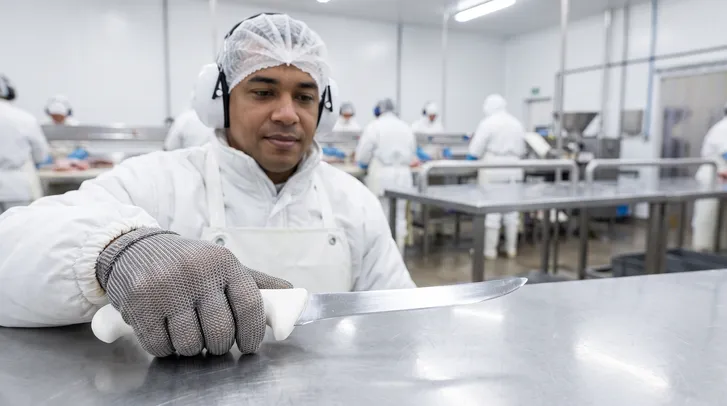
- Knives: the company must implement a system to control knife sharpening (36.8.10, b).
- Lifting loads: there must be a rotation of activities or breaks between periods of no more than two hours (36.5.4).
What PPE and clothing does NR 36 require for the cold?
- In activities with exposure to cold, clean socks must be provided and sanitised daily (36.10.1.2).
- Clothing must be changed daily (36.10.2.1).
- In cold environments, there must be a hand-warming system near the toilets or break areas (36.9.5.2).
How to apply NR 36 in practice
- Map the working hours. Set the psychophysiological break time for each shift using Table 1.
- Draw up the break schedule. Respect the 10 to 20 minutes per break and the prohibited times.
- Identify the cold environments. Apply the 20-minute break every 1h40 and display the maximum time in rooms at -18 °C or below.
- Organise the workstations. Ensure posture alternation and seating.
- Control knives and PPE. A sharpening system, and socks and clothing changed daily.
- Record everything. Schedules, PPE deliveries and training must be documented.
How GAP helps you comply with NR 36
GAP's PPE Management defines which PPE and clothing each role or department should receive, records every delivery with a digital signature or facial recognition, and alerts you when stock is low, which helps with items that are replaced frequently.
Employee Management tracks training, certificates and validity, with expiry alerts.
Want to manage your meat plant's PPE and training without paper? Schedule a demo.
Frequently asked questions about NR 36
What is NR 36?
It is the Brazilian Regulatory Standard that sets the minimum requirements for assessing, controlling and monitoring risks in the slaughter and processing of meat and meat products for human consumption. It was approved by MTE Ordinance No. 555/2013.
How much break time does NR 36 require?
It depends on the working hours: 20 minutes for a working day of up to 6h, 45 minutes for up to 7h20 and 60 minutes for up to 8h48 (item 36.13.2, Table 1). Each break must last between 10 and 20 minutes.
What is the NR 36 thermal recovery break?
In artificially cold environments, 20 minutes of rest after 1 hour and 40 minutes of continuous work, under article 253 of the CLT (item 36.13.1).
Can breaks be taken at the start of the working day?
No. Under item 36.13.2.6, breaks cannot be given in the first hour of work, alongside the meal break or at the end of the last hour of the working day.
What does NR 36 say about cold rooms?
In addition to the thermal recovery break, cold rooms at -18 °C or below must display the maximum time workers may stay inside (item 36.2.10.1.1).
Official sources
Read also