Standards
What Is NR 26? Safety Signage and the GHS
Understand what NR 26 establishes, the official rules for safety signage, the use of the GHS in labelling and the preparation of the Safety Data Sheet.
By: Vitória Willemann
Understand what NR 26 establishes, the official rules for safety signage, the use of the GHS in labelling and the preparation of the Safety Data Sheet.
By: Vitória Willemann
Standardised visual identification of risks and correct labelling of chemicals are primary requirements for preventing accidents and occupational diseases. A lack of clear information about the hazards present in the workplace or in the materials handled directly compromises the safety of operations and the effectiveness of emergency measures.
To standardise safety signage and the classification of substances in Brazilian companies, Brazil's Ministry of Labour and Employment sets out NR 26. This article details the regulatory guidelines for colour-coded signage and the strict alignment of chemical labelling with global standards.
Regulatory Standard 26 (NR-26) sets out measures for safety signage and identification to be adopted in workplaces, in order to indicate and warn of existing hazards and risks.
The standard requires the colours used to identify safety equipment, mark out areas and identify pipes carrying liquids and gases to comply with the official technical standards (such as those of ABNT, the Brazilian Association of Technical Standards).
NR 26 makes two important technical caveats about this practice:
The standard requires every chemical used in the workplace to be classified according to the criteria of the United Nations GHS (Globally Harmonized System of Classification and Labelling of Chemicals).
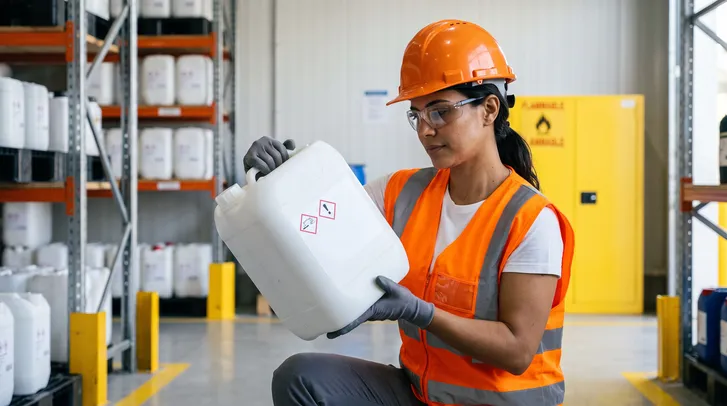
To communicate these risks, the company must use Precautionary Labelling. The label attached to the packaging of a product classified as hazardous must contain the following elements defined by the GHS:
The standard even requires chemicals not classified as hazardous under the GHS to have simplified labelling (containing the name, an indication that it is not hazardous and precautionary recommendations).
In addition to the label, the manufacturer or supplier must prepare and make available a Safety Data Sheet (SDS, known in Brazil as FDS, Ficha com Dados de Segurança) for every chemical classified as hazardous. The format of this document must also follow the structured GHS standard.
The purchasing organisation's responsibility does not end when the product is bought. NR 26 requires two practical actions from the employer regarding the team:
Not any more. The current wording of NR 26 does not list the colours in its body text. It expressly states that signage must follow the official technical standards. To identify pipes, for example, engineering teams and the SESMT (the company's Specialised Service in Safety Engineering and Occupational Medicine) must consult the applicable ABNT technical standard.
According to item 26.4.2.4 of NR 26, products notified or registered as sanitising products with ANVISA (Brazil's National Health Surveillance Agency) are exempt from the precautionary labelling obligations set by the standard, as they already follow ANVISA's own requirements.
Yes. NR 26 states that, for mixtures, the Safety Data Sheet must state the name and concentration (or range) of the substances that pose a hazard to workers' health (when present at a concentration equal to or above the GHS cut-off limits) and that have an established occupational exposure limit.
Understand NR 25, the safety rules for handling, storing and disposing of industrial waste (solid, liquid and gaseous) and the occupational risk involved.
Understand NR 22, the rules for mining in Brazil, how the CIPAMIN works and the requirements of the sector's Risk Management Programme (PGR).
Understand what NR 21 establishes, the requirements for protection against the weather, the rules on worker housing and how it relates to NRs 18 and 31.
Understand what NR 20 (updated in 2025) establishes, the rules for storing and handling flammables, the standard's Classes and the Facility File.
Understand what NR 19 establishes, the strict rules for manufacturing, handling and storing explosives, and the technical prohibitions updated by the MTE.
Understand what NR 16 is, which activities entitle workers to the 30% hazardous work allowance on their base salary and how the technical classification is done.
Simplify your Risk Management, reducing liabilities and ensuring safe, standardized, and auditable operations with fast implementation and advisory support.