Usually, the answer to the question of what an access control system is for seems obvious: to decide who enters and who leaves a facility. However, for industrial and corporate management, this purely asset-protection view leaves the operation exposed to hidden risks.
Today, a vulnerable security gate does not just result in theft or physical intrusions. Allowing a service provider with expired documentation to enter or granting an employee access to a hazardous area without proper training can generate labor liabilities and the risk of plant shutdown.
In this scenario, an access control system is no longer exclusive to asset security and becomes an essential tool for Compliance, Human Resources, and Occupational Safety and Health (OSH).
In practice: what is an access control system for?
When management decides to modernize its processes, it seeks traceability and automation. The purpose of an efficient access control system is to reduce dependency on manual human verification when clearing people and vehicles.
Below, we detail some reasons to implement this technology in complex operations:
1. Modernization of access gate control
The first challenge for any large factory or construction site is the guardhouse. Manual access control, where the guard must check physical documents and call the responsible department to request authorization, creates queues at peak times and leaves room for clearance errors.
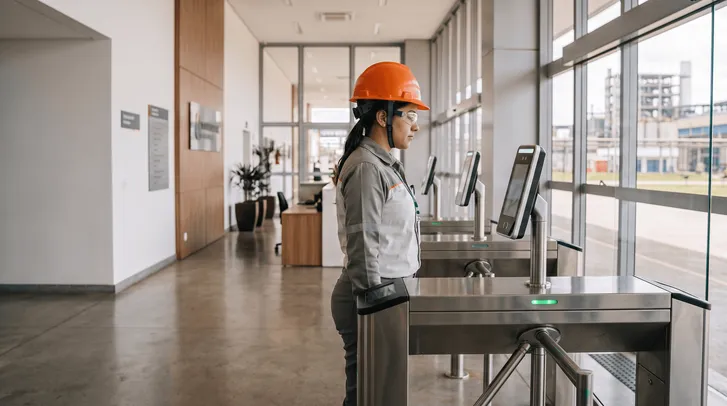
With a digitalized system, upon arriving at the security gate, clearance happens much faster, with an exact record of the date, time, location, and person visited, keeping the history saved in the cloud for future reference.
2. Legal and operational shielding via integration with turnstiles
By linking access control to Contractor Management software or the OSH module, the physical turnstile starts cross-referencing operational data in real time. For example: if a third-party service provider tries to enter the factory, but the system identifies that their medical exam (ASO) expired the day before, the integration with turnstiles automatically blocks entry.
This ensures that the workforce within your operation complies with Regulatory Standards (NRs) and labor legislation, reducing the risk of co-responsibility.
3. Fraud prevention with facial recognition
Badge sharing (when an employee "punches the clock" or unlocks the turnstile for a colleague) is a common flaw that compromises security and work hour controls.
To resolve this issue, the use of facial recognition has become one of the most efficient technologies in the industry. By linking turnstile clearance to facial biometrics, the company has the guarantee that whoever is accessing the area is, in fact, the authorized person. Besides preventing fraud, the technology allows for faster entry and avoids mechanical problems that typically occur with traditional card readers.
When evaluating market options, avoid generic solutions that function solely as isolated gate control software. For the technology to deliver real results, look out for the following requirements:
- Communication with varied hardware: The system must communicate well with turnstiles, full-height turnstiles, vehicle gates, and facial recognition terminals from different consolidated brands on the market.
- Departmental integration: The solution needs to connect not only with corporate security, but also cross-reference data with the Human Resources and Occupational Safety areas.
- Fair pricing model: Prefer platforms that offer unlimited administrative access. This allows leaders from different sectors to consult access reports without generating extra costs per logged-in user license.
Your security gate cannot rely on slow, manual processes. GAP Sistemas' access control technology connects physical security, contractor management, and document control in a single environment.
Gain more visibility into who accesses your operation.
Speak to our team now and see how our solutions can simplify your operation's routine.