Work Permit
WP (Work Permit): how to reduce errors in management?
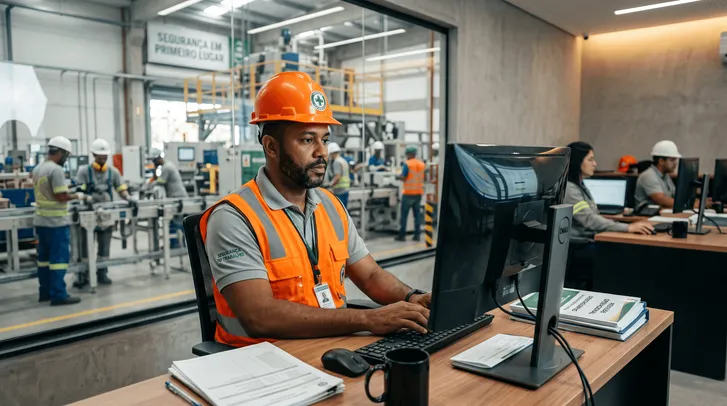
Learn how to reduce errors in PT (Work Permit) management. Understand the lifecycle, from risk analysis to issuance, and how technology can help.
By: Guilherme Herker
Learn how to reduce errors in PT (Work Permit) management. Understand the lifecycle, from risk analysis to issuance, and how technology can help.
By: Guilherme Herker
The Work Permit (PT) is one of the most critical documents in safety management of any operation. It is the formal guarantee that a hazardous activity was planned, analyzed, and authorized, aiming to protect the integrity of everyone involved. However, managing this process manually is full of pitfalls that can lead to serious errors.
In this article, we will explore the fundamental role of the PT, its full lifecycle, and how digitization is the key to eliminating failures and strengthening safety in your workplace.
Work permits are documents that authorize the execution of activities that present high risks to the safety of employees. They are essential to ensure that all standards are followed and that workers are fully aware of the dangers involved in their tasks.
The PT must be issued and filled out whenever services such as work in confined spaces (NR-33), hot work (welding, cutting), work at heights (NR-35), excavations, demolitions, or high voltage are performed, as required by regulatory standards. It also helps to ensure that all necessary resources are available before starting the activity, minimizing interruptions that could compromise safety.
To understand how to reduce errors, it is crucial to know the correct flow. A PT is a living document that goes through several stages, involving different responsible parties and critical information.
First and foremost, the issuance of the PT begins with a detailed risk analysis of the workplace. This analysis identifies the hazards and establishes the necessary preventive measures, which may include the use of specific personal protective equipment (PPE), area isolation, and emergency procedures.
The permit can only be issued by a trained and authorized professional (such as a supervisor or safety technician). The document must contain the minimum information requirements, such as the exact description of the service, the names of the people involved, the validity date and time, the tools to be used, and the mandatory PPE.
During execution, the PT must remain visible at the site. After the completion of the service, the responsible team must conduct a final inspection, ensure the area is clean and safe, and then proceed with the formal closure of the PT, with the appropriate signatures.
Manual management can end up resulting in recurring failures, such as:
These failures can lead to accidents, fines, and even labor lawsuits, compromising the integrity of the team and the company's reputation.
The first major step to eliminate manual errors in work permit management can be the adoption of a digital platform. Solutions that allow centralized management, like GEC, automate and bring more efficiency to permit management, eliminating risks such as document loss and ensuring access to correct and updated information for all employees.
With automation, if any document needs to be renewed, the system will send notifications to ensure this is done in a timely manner. This is because all permits are stored in one place, which facilitates access and consultation. In this way, tracking is easy, which can be very useful in cases of internal and external audits.
Implementing a good tool that will facilitate your team's work is only part of the solution. For it to be successful, it is important that all employees are trained to use the system and perform tasks competently and safely.
Here at GAP Sistemas, support for implementing one of our solutions is ongoing and involves interactive training sessions to introduce the new tool and clarify doubts, easy-access materials that explain step-by-step how to use the system, and much more.
Outdated information is one of the greatest risks to work permits. It is vital to ensure that all permits are regularly reviewed and updated according to the activity carried out.
Knowing this, it is important to establish a schedule to review and update existing permits, using the solution's alert feature to notify when permits are about to expire or when new risks are identified. Keeping a history of changes in permits also facilitates compliance monitoring and auditing.
Digitizing work permit management is a smart strategy to reduce errors in EHS management and ensure compliance in operations. With the right solution, good training, and continuous monitoring, your company can transform this process into something agile and secure.
Are you ready to accelerate work permit management in your company? Talk to our experts and discover how our solutions can really make a difference!
Find out what NR 13 establishes, why safety inspections of boilers and pressure vessels matter, and the role of the Qualified Professional (PH).
Understand the NR 11 rules for safe transport, handling, storage and manipulation of materials with forklifts, overhead cranes and cranes.
Understand what the updated NR 9 is, how it governs the assessment of physical, chemical and biological agents, and its direct link with the PGR (NR 1).
Get to know NR 8 and understand the technical requirements for ensuring the safety, thermal comfort and structural stability of buildings used as workplaces.
Understand what NR 6 is, the employer's responsibilities when issuing PPE, the worker's duties and how to streamline PPE control in your company.
Understand what NR 5 is, its sizing rules, the election process deadlines and the standard's new requirements on combating harassment in companies.
Simplify your Risk Management, reducing liabilities and ensuring safe, standardized, and auditable operations with fast implementation and advisory support.