Standards
What Is NR-24? Rules on Sanitary Conditions and Comfort at Work
Understand NR-24, what it requires for toilets, changing rooms, canteens and accommodation, and how to guarantee workers' comfort.
By: Vitória Willemann
Understand NR-24, what it requires for toilets, changing rooms, canteens and accommodation, and how to guarantee workers' comfort.
By: Vitória Willemann
Environment, Health and Safety (EHS) management is not limited to preventing operational accidents directly. Maintaining a healthy working environment with adequate infrastructure for the team's basic needs is both a legal obligation and a critical factor for occupational health.
To standardise these infrastructure requirements, the Brazilian Ministry of Labour sets specific guidelines. If you are unsure what NR-24 is and how to apply it, this article details the updated normative parameters for sanitary facilities, eating areas and changing rooms.
Regulatory Standard 24 (NR-24) establishes the rules and minimum parameters for Sanitary Conditions and Comfort in Workplaces.
Its purpose is to ensure that every company provides decent infrastructure to its workers, preventing illness caused by poor hygiene and guaranteeing adequate conditions for breaks, meals, personal hygiene and rest (where accommodation is provided). The rules vary according to headcount and the activity's risk level.
The standard divides comfort and sanitation requirements into structural categories. The EHS department and the company's civil engineering or architecture team must work together to guarantee compliance in the following areas:
NR-24 sets strict sizing parameters. As a general rule there must be a minimum ratio and separation by sex (except in commercial or administrative establishments with up to 10 workers, where a shared toilet is allowed provided privacy is guaranteed). Facilities must have impermeable, washable floors and walls, adequate ventilation and a constant supply of water, liquid soap and paper towels.
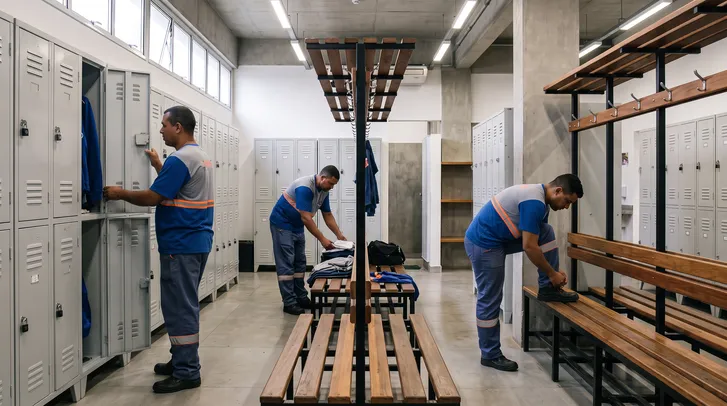
Changing rooms are mandatory when the activity requires the worker to change clothes, or when the company requires uniforms or Personal Protective Equipment (PPE). They are also mandatory in activities involving exposure to moisture, dust, intense heat or toxic products. The area must include individual lockers and showers sized according to the number of workers.
For companies with more than 30 workers, a specific area for meals is mandatory. It must offer enough seats and tables, drinking water, ventilation and a way to heat food. For work fronts with fewer than 30 workers the structural requirements are relaxed, but the employer must still guarantee cleanliness, adequate seating and drinking water.
Where the company requires a uniform, it must be supplied free of charge. One technical point of attention in NR-24: the company is responsible for cleaning the clothing daily whenever there is contact with harmful products, biological agents or toxic substances that cannot be washed in the worker's home.
Non-compliance with NR-24 is one of the main reasons for citations from the Ministry of Labour. Degraded toilets, missing basic hygiene supplies or inadequate canteens create serious labour liabilities and immediate dissatisfaction on the operational team.
To avoid these scenarios and protect the company from fines, infrastructure checks should be part of the safety team's daily rounds. Applying a rigorous workplace safety inspection checklist focused on facilities ensures that leaks, poor cleaning or structural damage are fixed by maintenance before they become legal infractions or complaints.
Keeping track of the condition of dozens of toilets, changing rooms and canteens across a large industrial plant takes organisation. How has your team been recording and monitoring sanitary conditions at the work fronts?
Learn how to build an equipment maintenance plan, its impact on accident prevention (NR-12) and why digitising checklists and inspections matters.
Discover what Regulatory Standards are, how many NRs are currently in force in Brazil, and get an overview of the main EHS standards.
Understand what NR 23 is, the fire protection standard, its requirements for escape routes and its relationship with the state AVCB in occupational safety.
Understand what NR 01 is, the foundational occupational safety standard, and how the Occupational Risk Management (GRO) guidelines affect your operation.
Understand the challenge of unifying the safety culture when outsourcing services, and how to bring contractors' workers into your EHS routines.
Understand what the CA (Approval Certificate) for PPE is, how to look it up at the Ministry of Labour, and the advantages of digital PPE control.
Simplify your Risk Management, reducing liabilities and ensuring safe, standardized, and auditable operations with fast implementation and advisory support.