Outsourcing services makes it possible to carry out specialised operational activities such as electromechanical assembly, facilities and industrial maintenance. The presence of several contractors inside the same perimeter, however, demands more from the SESMT than documentary control alone. The major structural challenge is unifying the prevention culture.
The disparity in how safety standards are applied and how risks are perceived between a company's own employees and outsourced workers is one of the main causes of operational deviations at work fronts.
In this article we detail how to bring outsourced workers into your operation's Environment, Health and Safety (EHS) routines, guaranteeing the same level of prevention and technical rigour across every area of the plant.
Extending the EHS culture to partner companies
Consolidating a safe environment depends on the premise that safety transcends the employment relationship. When an operation adopts outsourcing, the hiring company must make it clear that the service provider will operate under the contracting party's EHS guidelines and values.
Many companies focus exclusively on legal protection but forget that real prevention happens at the front line. Outsourced workers often come from different organisational realities, with different levels of safety maturity. If the contracting party's rules are not actively applied to these professionals, the door opens to operational negligence.
Leadership at the contracted companies must take an active part in the plant's safety meetings and committees. This active alignment drastically reduces accidents, and it is a fundamental step towards understanding how effective risk management protects your company when outsourcing services, minimising exposure to labour liabilities.
Induction and alignment of operational risks
Safety induction is the outsourced worker's first and most important point of contact with your company's requirements. Compliance with NR-1 requires service providers to be instructed on the plant's general hazards, not only on the isolated tasks they came to perform.
Induction training must level the worker's technical knowledge of the operation's hazards, guaranteeing that they understand how the area works before accessing the shop floor. Induction must necessarily cover:
- The rules for releasing work fronts and issuing the Work Permit (PT).
- Hazardous energy lockout procedures (LOTO).
- Emergency routes and the area evacuation plan.
- The channels for reporting unsafe conditions and operational deviations.
Unifying the routine on the shop floor
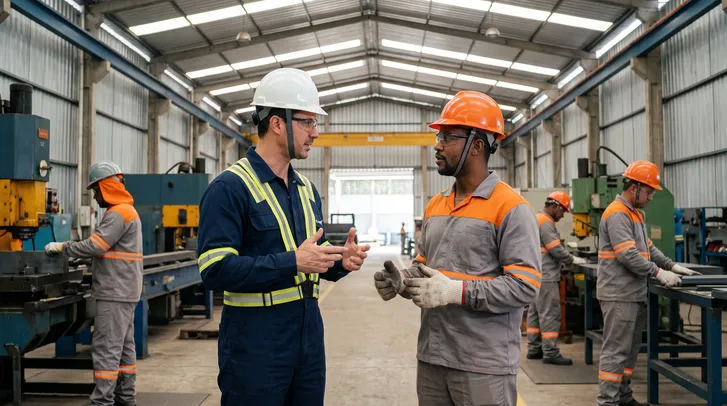
The operation cannot allow different safety standards for direct and indirect employees. In operational practice, everyone must follow the same preventive routines. The contracting party's EHS team must audit whether partners are running the Daily Safety Dialogue (DDS), completing tool checklists and using PPE correctly.
To make that unification viable and to audit rule compliance at scale, adopting digital processes is indispensable. Using a technical platform centralises information and connects behaviour in the field with the partner's employee document control, showing in practice that it is possible to outsource services and reduce risks at the same time.
Solutions such as GAP Sistemas' Contractor Management module automate the validation of induction training, block irregular workers at the gate and provide compliance indicators for every supplier. The contracting party thereby guarantees that EHS requirements are applied end to end, without depending on manual inspections.
The plant's continuous safety depends on the technical engagement of everyone working on site. How does your operation audit and guarantee that contracted companies are following the same safety rules as your direct employees?