PPE Management
What is EPC in Occupational Safety?
Understand once and for all what EPC (Collective Protective Equipment) is and its importance in occupational safety. See the main types and practical examples.
By: Willian Candelório
Understand once and for all what EPC (Collective Protective Equipment) is and its importance in occupational safety. See the main types and practical examples.
By: Willian Candelório
In the field of occupational safety, the protection of employees is achieved through different levels of measures. Among the most well-known are Personal Protective Equipment (PPE). However, an effective safety strategy prioritizes an earlier and more comprehensive approach: Collective Protective Equipment (CPE).
This technical article explores in detail what a CPE is, its fundamental position in the hierarchy of hazard control, and its crucial distinction from PPE, with practical examples of its application.
In a direct way, a CPE is any device, system, or equipment, fixed or mobile, installed in the work environment with the purpose of protecting one or more people simultaneously against a certain risk.
The main characteristic of CPE is that its effectiveness is not conditioned on the action or decision of a single worker. It is an engineering or administrative measure integrated into the environment, acting constantly to guarantee the safety of all individuals present in that area.
Understanding the distinction between CPE and PPE is fundamental, as it is based on the principle of the Hierarchy of Hazard Control. This concept, which is the foundation of modern occupational safety, establishes an order of priority for protective measures.
The logic is to prioritize actions that eliminate or neutralize the hazard at its source, in the environment, before protecting the individual. The sequence of priority is: elimination, substitution, engineering controls, administrative controls, and PPE.
Therefore, HPE/CPE acts at the source of the hazard, while PPE acts on the worker, minimizing the consequences if a failure in the previous controls occurs.
To facilitate understanding, CPEs can be categorized according to the type of hazard they aim to control:
Fundamental for any activity at height, such as:
Guardrails and Toe boards: Robust physical barriers installed at the edges of slabs, scaffolding, and openings.
Safety Nets: Installed in voids or under work areas to intercept the fall of people or materials.
Elevating Work Platforms and Scaffolding: When properly designed and assembled, they constitute a safe working surface.
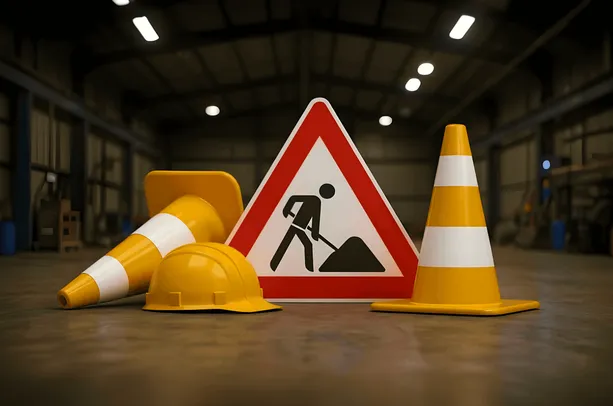
Used to isolate areas, guide flow, and visually warn of hazards.
Cones, Tapes, and Hazard Barriers: Temporarily demarcate hazard areas, such as locations undergoing maintenance or with slippery floors.
Warning and Safety Signs: Inform about specific hazards ("High Voltage") or obligations ("PPE Mandatory").
Audible and Visual Alert Systems: Such as sirens on overhead cranes or backup alarms on industrial vehicles.
Devices for rapid response to fires or chemical accidents.
Fire Extinguishers, Hydrants, and Sprinklers: Systems to fight initial fires.
Emergency Showers and Eye Wash Stations: Essential in locations with handling of aggressive chemicals.
Control harmful agents directly in the environment.
The implementation of CPEs is an indicator of the maturity of a company's safety management. Its main benefits are:
The obligation to implement CPEs is established in several Regulatory Standards, according to the hazard addressed. Although there is no single NR for CPEs as NR-6 is for PPE, their requirement is clear in texts such as:
Simply installing a CPE is not enough. It is a legal and technical responsibility of the company to ensure its continuous effectiveness through a management program that includes:
Managing these assets, such as controlling extinguisher charge expiration dates or calibrating gas detectors, is a complex task. Therefore, EHS management systems are used to automate these controls, schedule maintenance, and ensure that all CPEs are always operational and in compliance.
In summary, the implementation and prioritization of Collective Protective Equipment are direct indicators of the maturity of a company's safety culture. Protection integrated into the work environment is the most efficient and safe approach. The maxim of modern safety is confirmed: the most effective protection is that which acts at the source of the hazard, making personal protection the last, and not the first, barrier.
Understand what NR 14 is, the mandatory requirements for installing, lining and safely operating industrial furnaces, and how to avoid explosion risks.
Find out what NR 13 establishes, why safety inspections of boilers and pressure vessels matter, and the role of the Qualified Professional (PH).
Understand the NR 11 rules for safe transport, handling, storage and manipulation of materials with forklifts, overhead cranes and cranes.
Understand what the updated NR 9 is, how it governs the assessment of physical, chemical and biological agents, and its direct link with the PGR (NR 1).
Get to know NR 8 and understand the technical requirements for ensuring the safety, thermal comfort and structural stability of buildings used as workplaces.
Understand what NR 6 is, the employer's responsibilities when issuing PPE, the worker's duties and how to streamline PPE control in your company.
Simplify your Risk Management, reducing liabilities and ensuring safe, standardized, and auditable operations with fast implementation and advisory support.